About Living Stones
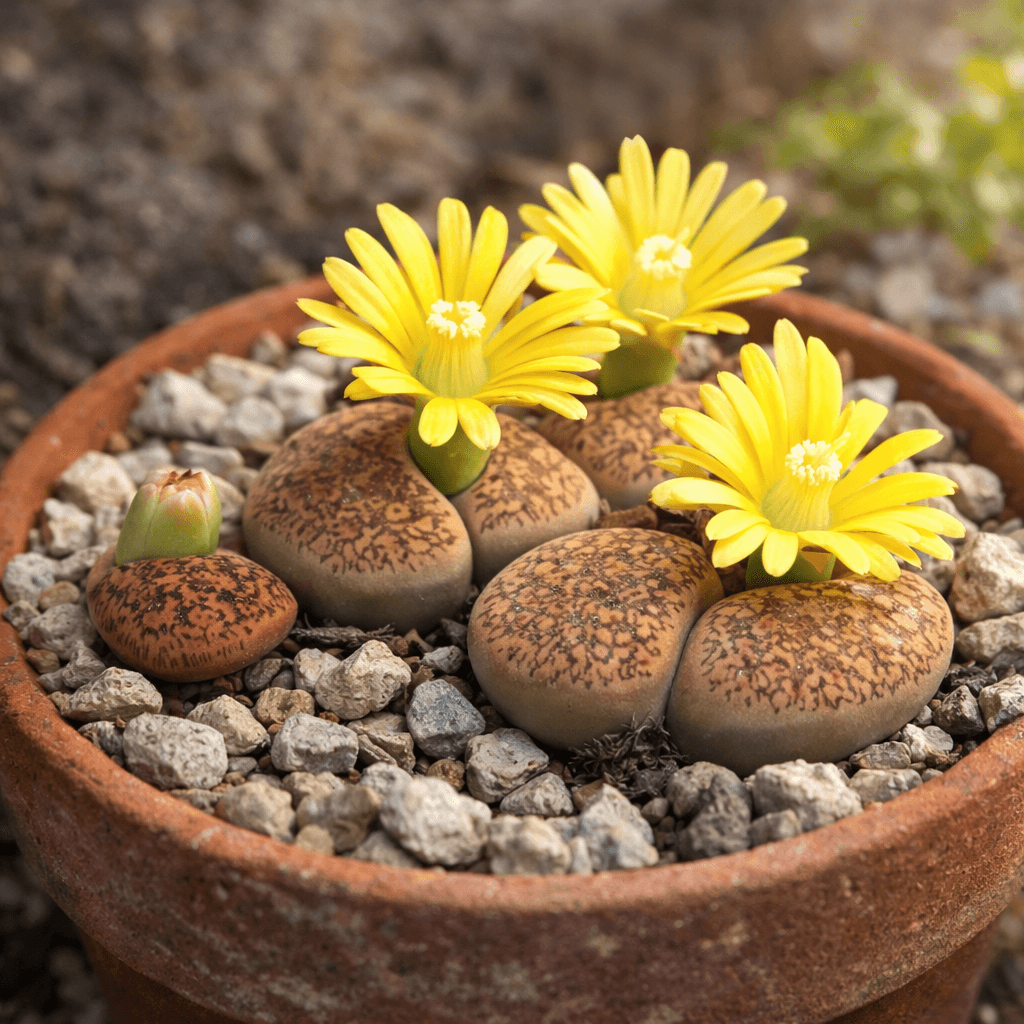
Lithops are among the most extraordinary plants on Earth — tiny succulents that have evolved to perfectly mimic stones and pebbles as camouflage against herbivores in their native South African habitat. Each plant consists of a pair of thick, fleshy leaves fused together with a slit across the top from which flowers emerge. Conophytum bilobum is a related "living stone" with a distinctly bilobed (two-humped) shape. Both are slow-growing, long-lived, and endlessly fascinating.
Light
Living stones need bright light — at least 5 to 6 hours of direct or very bright indirect light daily. South-facing windows are ideal. Insufficient light causes etiolation — the plant stretches upward and loses its characteristic compact, stone-like form. However, protect from the most intense midday sun in very hot climates, as they can scorch.
The Unique Watering Cycle
This is the critical knowledge for lithops and conophytum care — they follow a very specific annual cycle that differs from all other succulents:
Late summer through fall (growing season): Water every 2 weeks when the plant is actively growing and may produce flowers.
Winter through spring (leaf absorption): Stop watering entirely. During this period, the plant absorbs its old leaf pair to produce a new one. Any added water interrupts this process and can kill the plant.
Late spring through summer (dormancy): Resume very light watering only when the old leaves have completely dried into papery husks and the new leaf pair is visible.
When in doubt, don't water. Lithops die far more often from overwatering than underwatering.
Soil
Use the grittiest soil possible — up to 70-80% mineral content (pumice, perlite, coarse sand, or fine gravel) with 20-30% potting soil. Standard cactus mix alone retains too much moisture for living stones. They need almost zero organic matter.
Display & Patience
Lithops and conophytum are very slow growers — don't expect rapid changes. They're best displayed in shallow pots or trays, grouped together to mimic a natural pebble field. Mix in a few real pebbles for an authentic "stone garden" effect. They pair well with other slow-growing species like Euphorbia obesa. Repot rarely — only when absolutely necessary, as they dislike root disturbance.