
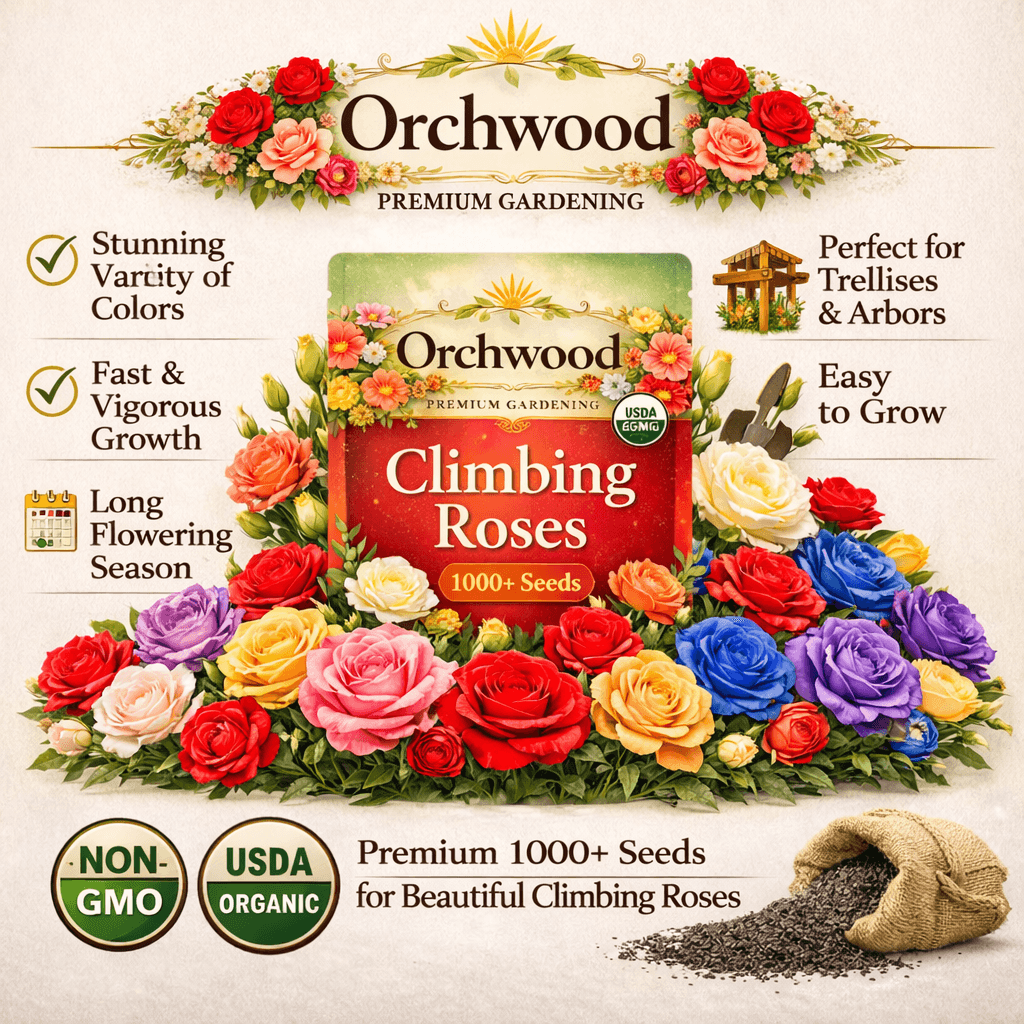
About Climbing Roses
Climbing roses produce long, flexible canes that can be trained along fences, arbors, trellises, and walls to create spectacular displays of blooms. They produce flowers in flushes throughout the growing season — from classic reds and pinks to whites and stunning bicolors like our twin red-and-white variety. A single mature climbing rose can cover a 10-foot section of fence with hundreds of blooms.
Starting from Seed
Growing roses from seed is a rewarding long-term project. Soak seeds in a dilute hydrogen peroxide solution for 24 hours, then cold-stratify in the refrigerator in a damp paper towel for 6 to 10 weeks. Sow stratified seeds 1/4 inch deep in moist seed-starting mix at 70°F. Germination is irregular — some sprout in 4 weeks, others may take months. Seedlings need strong light and careful watering.
Planting Out
Plant in full sun — at least 6 hours daily — with good air circulation. Space 6 to 10 feet apart to allow for mature spread. Plant in rich, well-drained soil amended generously with compost. Dig a hole twice as wide as the root ball and plant at the same depth the rose was growing in its pot. Install your support structure before planting — a sturdy trellis, horizontal wire system, or arbor.
The Horizontal Training Secret
This is the single most important technique for climbing roses: train the main canes horizontally rather than letting them grow straight up. When a cane is angled horizontally or arched in a curve, it slows sap flow and triggers the production of flowering side shoots along its entire length. A vertical cane typically blooms only at the very top. Fan canes out across your support in a wide, roughly horizontal pattern, tying them with soft plant ties.
Pruning & Ongoing Care
Prune annually in late winter (January-February) while fully dormant. Remove dead, damaged, or crossing canes. Cut back lateral flowering shoots to 2-3 buds from the main cane. Avoid heavy pruning that removes all new wood. During the growing season, deadhead spent blooms promptly to encourage repeat flowering. Feed with a rose-specific fertilizer in spring and after the first bloom flush. Water deeply once or twice weekly. Plant creeping thyme or dianthus at the base for a classic combination, and pair with climbing jasmine on shared structures for fragrance and continuous interest.